THE REVIEW / Puzzle adventure
ANIMAL WELL
A dense discovery game for players who enjoy testing ideas without a running explanation. Seemingly ordinary tools invite unexpected uses, making experimentation more valuable than following a long tutorial.

The programme
Game facts
- Developer
- Billy Basso
- Publisher
- Bigmode
- Released
- 9 May 2024
- Platforms
- Windows (Steam edition)
- Model
- Paid game
- PEGI
- 7 · Fear, Mild Violence — Steam UK listing
- Players
- Single-player
- Length
- Short
- Difficulty
- 3 / 5 · Challenging
- Steam Deck
- Verified
PEGI source ↗ · Steam Deck status source ↗
Edition: Base game
The score, explained
The interest and responsiveness of the core decisions and actions.
How progression, exploration and goals fit together.
The coherence of the visual, musical and narrative presentation.
How clearly the game explains its rules and offers useful ways to engage.
The depth of optional goals, alternative approaches and reasons to return.
Learning what the well allows
Animal Well makes an ordinary-looking object a better reward than a larger damage number. Its interconnected rooms, creatures and tools are designed to react to one another, so the useful question is often what an item might do here rather than which weapon is strongest. The publisher explicitly describes multiple uses for every item and an emphasis on tension over action. That gives the adventure a persuasive identity: progress belongs to the player's understanding as well as the inventory. Our assessment favours that tightly connected design. It also comes with a clear trade-off. Anyone who wants every upgrade explained immediately, or expects enemies to be cleared before considering a room solved, may find the deliberate uncertainty frustrating.
A map that changes in your head
The nonlinear structure makes revisiting an area part of the main attraction. Lighting candles and filling in the map provide practical anchors, while a new tool can alter what an earlier space appears to contain. The important distinction is between repetitive travel and returning with a better question. Animal Well's available systems give that second kind of return a strong foundation. Secrets also extend beyond the main route, so reaching an ending and exhausting the environment are different aims. We would approach the map as a collection of unresolved observations, not a checklist that must be completed on first contact. Players who enjoy keeping small notes have an obvious way to organise their own discoveries without flattening them into a walkthrough.
Small figures, imposing surroundings
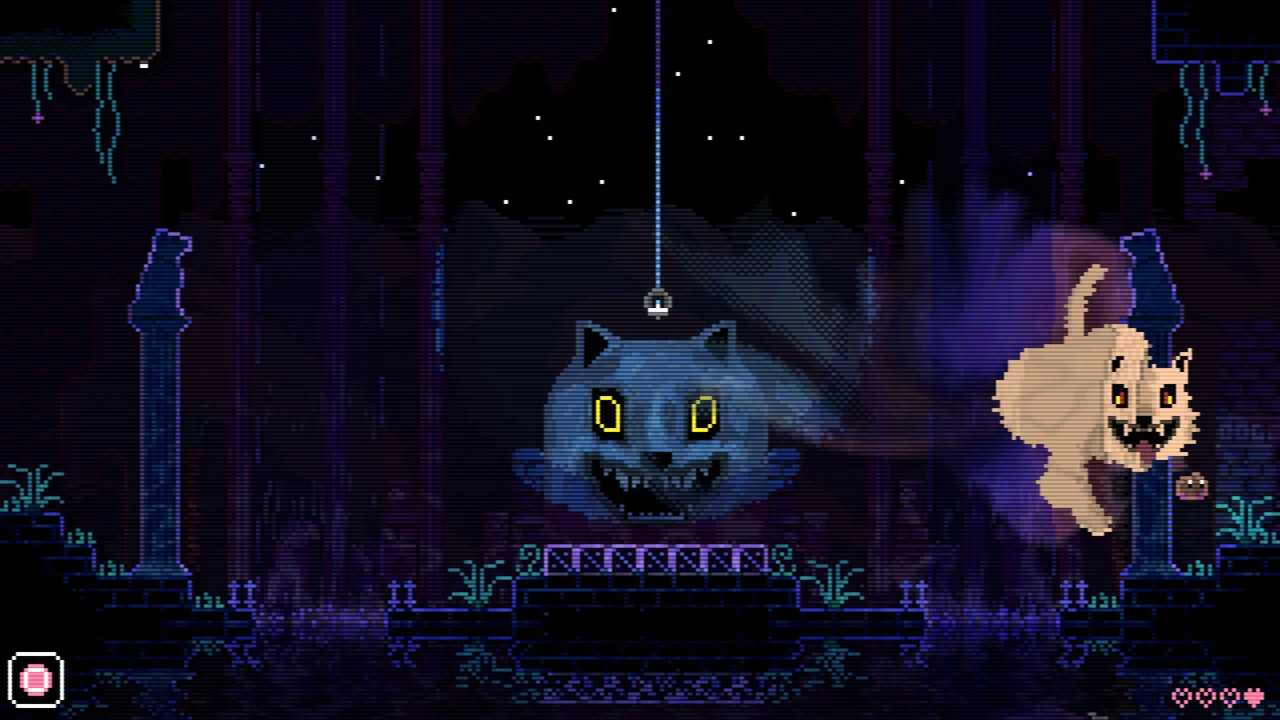
The pixel artwork gives the small playable creature an effective relationship with the surrounding animals and machinery. Scale can make an encounter unsettling before any attack occurs, which suits a game that leaves the player comparatively vulnerable. Lighting and carefully distinguished rooms are therefore more than decoration: they help make places memorable when the route loops back on itself. The game presents both playful and threatening creatures, avoiding a single mood across the whole journey. We rate the presentation highly because it reinforces curiosity and caution together. A seemingly modest item can change how several rooms work once you understand another use for it. The dense map rewards remembering unusual details, so discoveries often alter your reading of an old location instead of merely opening a new corridor.
Choose it for the unanswered questions
Animal Well is strongest as a recommendation for someone who wants to investigate, form a theory and occasionally discover that the theory was wrong. Its appeal does not depend on a large party, elaborate dialogue choices or a constant stream of combat loot. That narrow focus can make individual discoveries feel more connected to one another, while also leaving fewer alternative activities when a puzzle resists an answer. The lasting attraction is the possibility of finding another relationship inside a familiar world. Our replay assessment reflects those available layers of secrets, not an estimate of how long every player will spend. For a clearer action emphasis within a similarly mysterious adventure, TUNIC is the more appropriate comparison in this catalogue. Seemingly ordinary tools invite unexpected uses, making experimentation more valuable than following a long tutorial.
The verdict
A dense discovery game for players who enjoy testing ideas without a running explanation. Seemingly ordinary tools invite unexpected uses, making experimentation more valuable than following a long tutorial.
Reasons to play
- Multipurpose items encourage lateral thinking
- Connected world makes discoveries useful elsewhere
- Atmosphere supports the puzzle design
Reasons to think twice
- Limited explanation can leave progress uncertain
- Players seeking regular combat rewards may find it restrained
See the game

Assist & accessibility
Explore the available settings and control options on the official game page before choosing your setup.
Parents’ guide
Players: Single-player. No in-game purchase marker in the checked Steam listing. Separate downloadable content may be sold.
Age classification: 7. Fear · Mild Violence Steam UK listing
A useful starting tip
When you acquire an item, revisit a familiar room and test more than its most obvious use.
A different direction
Compare this with TUNIC: TUNIC is a strong choice for players who want combat and exploration built around discovering the rules for themselves.
Official sources
Reviewed: November 2026
You might also like
 TUNICRead review →
 Chicory: A Colorful TaleRead review →
 InscryptionRead review →